

Lira, northern Uganda. The bishop of the diocese had asked the Comboni Missionary Sisters to care for adults living with AIDS. When Sister Maria Marrone, a nurse and midwife, arrived from Karamoja to take over from the sister who had preceded her, her attention was drawn elsewhere. One day she went with her predecessor to pay the school fees of the children of sick parents, and in a single day she saw between 100 and 150 HIV-positive children pass by. “I was shocked to see these children so sick, so thin, so sad,” she recalls. “I saw a lot of attention for the adults, and I kept asking: but who helps the children?”
The answer came from a man, perhaps the uncle of some of them: “Who do you expect to help them? These children are all going to die.” The words stayed with her. “I felt a fire inside me, like Jeremiah. I said: no, I cannot accept this.” She asked to meet the provincial superior and travelled to Kampala. “I see many associations helping adults, but none helping children. Let me help the children,” she told her. The provincial agreed and took it upon herself to inform the bishop.
Sister Maria started with nothing. As she tried to imagine what could be done for those children, she remembered something she had seen during holidays in Italy: the parish summer camps known as Grest, with games, dances, music and an educational theme. She decided to organise one over Christmas, which in Uganda falls in the dry season, the season of hunger. “I kept thinking: my goodness, they are already little skeletons. In the hungry season it will be worse for them.” To run it, she asked a catechist to point her to some newly qualified teachers, young people not yet used to a fixed system.
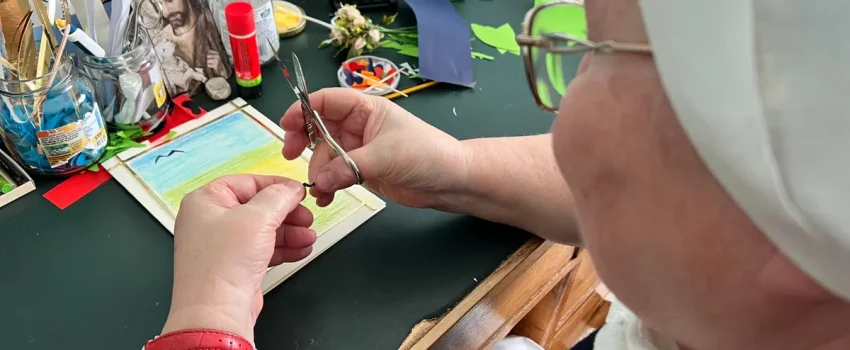
Her own training guided her too. While at nursing school in Italy, she had visited the Holy Family schools in Como, where children who had suffered brain injuries were helped to heal through art. Those were also the years when hospitals began changing the colours of operating theatres and decorating paediatric wards. “I saw how important colours were for children’s health, to give a positive message.” A sabbatical year in London, devoted to a course on the healing of memories, added another piece. From all of this came what might be called an art-based health camp. Sister Maria does not use that name herself, but she acknowledges that this is its purpose.
One question remained: what do children love? “Stories.” Sister Maria looked at the fairy tales available in the country’s schools but found them limited. “Many were about AIDS, many had a single message. But children need imagination; they need room for their minds to roam.” Her years in Uganda had also taught her something else: “Imagination is poor, because they live in a poor environment, in villages where there are only huts and earth.” Those who move to the city, she adds, mostly meet television and violent films. “The child lacks imagination. So I said: I’ll give it to them.” And so she began to write. “I tried to make some myself, and that’s how it started, because there was nothing.”
At the camp, every morning, some teachers collect the trays of art activities prepared for each class according to age, while others tell the stories. The children wait for them eagerly. “They would start saying ‘story, story, story’. They wanted the story.” The teachers enjoy them too, and when new ones are slow to arrive, they let her know. Sister Maria writes the texts, the teachers translate them into English, and she looks for suitable pictures to show the children. Childhood memories flow into her writing as well: the stories her grandmother used to tell when she came to help her mother.
Over more than ten years, the tales have multiplied. “I must have written a hundred, a hundred and fifty.” New ones are needed every year so that the children do not always hear the same ones. In recent months alone, during her stay in Italy, she has written another 24. They will be ready for the next camp, which begins in December. Once again, in the season of hunger, children who were once written off will find colours, games and new stories waiting for them.
Source: information provided by Sister Maria Marrone, Comboni missionary in Uganda, in an interview.